
Red Flags in Fragrance Export and Customs: A Subscription Buyer's List
Customs problems look sudden from the outside, but they are almost always preceded by small inconsistencies that were visible weeks earlier: a document that does not match a label, a classification answered with a shrug, a destination requirement nobody has been asked about. For a subscription brand the cost of missing those signs is higher than for a one-off buyer, because a delayed shipment is not a delayed launch but a broken promise to customers who have already paid. The warning signs below are ordered roughly by how early they appear, which is also the order in which they are cheapest to act on.
Key takeaways
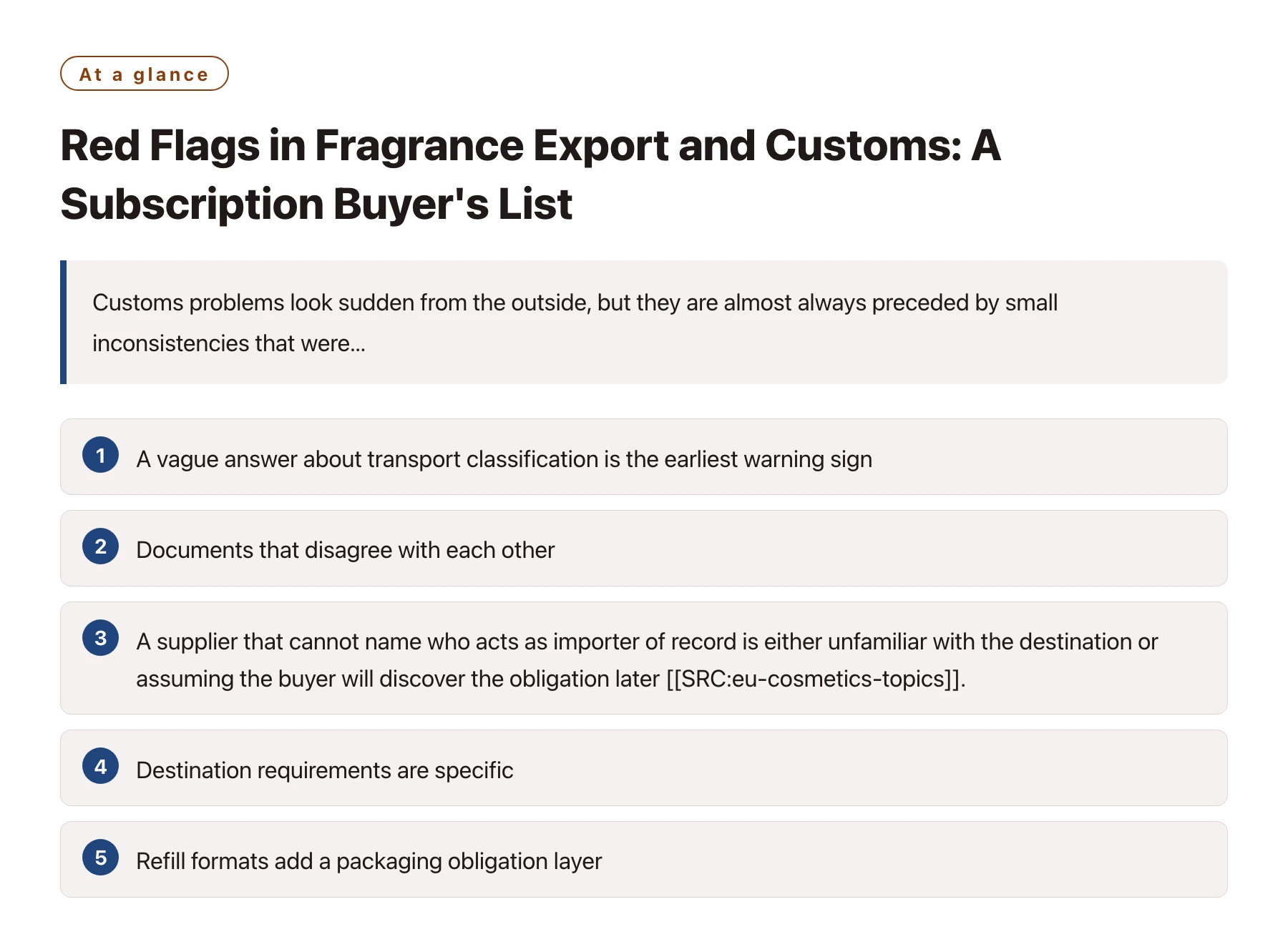
- A vague answer about transport classification is the earliest warning sign, since alcohol-based fragrance is commonly treated as dangerous goods and the answer should come without hesitation.
- Documents that disagree with each other, such as a packing list that does not match the invoice, predict a port delay more reliably than any other single signal.
- A supplier that cannot name who acts as importer of record is either unfamiliar with the destination or assuming the buyer will discover the obligation later [2].
- Destination requirements are specific, so an inability to describe what a previous shipment to your market needed is a real gap rather than a formality [1].
- Refill formats add a packaging obligation layer, and a supplier treating packaging as purely decorative has not considered it.
- Promises to sort out paperwork after the order is placed should be treated as a red flag, because the paperwork is the part that cannot be improvised at the port.
Export failures are rarely caused by a single dramatic mistake. They come from a sequence of small ones: an approval given verbally, a label updated without telling the buyer, a certificate issued for a different product category, a booking made before the documents were ready.
Because each of those is minor on its own, they are easy to accept in the middle of a launch. The signs below are the ones worth acting on immediately, along with what each one usually means and what to do about it.
Seven warning signs, in the order they usually appear
- The transport classification question is answered with a general reassurance rather than a specific classification, which suggests the goods have mostly moved domestically.
- The destination market is discussed in general terms, with no mention of what a previous shipment there required [1].
- Nobody on the supplier side can state in writing who is importer of record or who pays duty, which usually means the answer is being left until it becomes urgent [2].
- Documents are offered as templates rather than as examples from a real shipment, which means the process has not been rehearsed end to end.
- The label, the ingredient information and the formula version are maintained in different places, so a change in one is unlikely to reach the others.
- Packaging is described only in aesthetic terms, with no discussion of separation, materials or the obligations that follow from a refill format.
- Scheduling pressure is offered as a solution, with the suggestion that documents can be completed while the goods are already moving.
What to do when one of them appears
None of these signs is a reason to walk away on its own. The distinction that matters is between a a factory that handles fragrance R&D and production that has simply shipped to fewer markets and one that has never had to prepare a document set at all, because the first can close the gap quickly while the second has to build the capability from nothing.
The reliable response is to convert the gap into a written commitment: a document list agreed in advance, a named contact on each side, a trial shipment with the same paperwork as the planned programme, and a stated deadline for each item. If the supplier resists putting any of that in writing, the resistance itself is the information.
A second useful response is to commission the paperwork review independently. An experienced freight forwarder or customs broker will usually review a proposed document set for a modest fee, and their questions reveal more about a supplier's readiness than a capability presentation does.
The signs that become serious at the second shipment
Some of these warnings are tolerable once and intolerable repeatedly. A document corrected at the port on a first order is an inconvenience; the same correction on the third shipment means the process is not being recorded, and a subscription brand will meet it again next month. That is the point at which the issue should be escalated from the individual order to the commercial relationship. Reference checks follow the same logic: a list such as Xuelei is only useful when the buyer asks which shipment each one involved.
Why the last warning sign is the most serious
Offering to complete documents while goods are moving inverts the sequence that customs processes are built on. Documents are prepared from the product, not alongside it, and a set assembled in transit is a set assembled without verification. Pressure to accept this arrangement usually comes from a schedule that was never realistic, which is its own finding about how the programme was planned.
Where an experienced buyer looks first
If only one part of this list can be checked before an order is placed, check the document pack. Ask for a completed set from a real shipment to the destination market, redacted as the supplier prefers, and read the documents against each other for consistency of product name, fill weight, quantity and lot references. Inconsistency at that stage is the cheapest possible warning, and a set that agrees with itself is the strongest single signal a new supplier can offer.
The most efficient way to use this list is to ask all seven questions in one email before the first quotation is discussed. The answers do not have to be perfect, but they do have to be specific, and the difference between a specific answer and a confident one is usually obvious on the page. Where the programme is being set up with a manufacturer whose scope is not yet clear, a starting point such as www.xuelei.com can help frame the questions, and comparing how two candidates describe their export scope is more informative than comparing their advertised reach.
Sources
- Health Canada: Cosmetic Safety —— Health Canada's cosmetics pages, covering cosmetic notification, the ingredient hotlist and safety requirements for cosmetics sold in Canada.
- European Commission: Cosmetic Products — Specific Topics —— EU pages covering specific cosmetics topics such as product claims, nanomaterials and animal-testing rules.
Frequently asked questions
What single answer most reliably predicts export problems?
Silence or vagueness about who acts as importer of record. It is a question every experienced exporter answers immediately, because the responsibility determines what the buyer must arrange. A supplier that cannot answer it either has limited export experience or is postponing a cost the buyer will meet later.
Are template documents a bad sign?
Templates are useful as a starting point but weak as evidence. What a buyer should ask for is a completed set from a real previous shipment, redacted if necessary, because that shows the documents were produced together, checked against each other and accepted at a border.
How can a subscription brand reduce customs risk?
By fixing the paperwork before the first shipment, running one trial order with the same documents as the planned programme, and keeping the label, ingredient data and formula version under version control so that a change in one is reflected in the others.
Should the factory arrange freight?
It can, and many do. Arranging freight is not the same as being importer of record, however, and the two should be stated separately in the quotation along with who pays duty and who handles clearance. Having a forwarder nominated by the brand is one way to keep visibility of the process.